
Key events
-
Zelenskyy: Downing Street talks ‘small progress towards peace’
-
‘What is crucial is unity between Europe, Ukraine and US,’ Zelenskyy says after London talks
-
‘Europe has means and will to increase pressure on Russia,’ EU’s von der Leyen insists
-
Europe’s leaders can no longer deny that the relationship with US has changed — analysis
-
Zelenskyy leaves Downing Street after latest Ukraine talks
-
Crete airport sees disruptions amid growing farmer protests over subsidy payments
-
Macron, Merz leave Downing Street after talks with Zelenskyy
-
Starmer meets Zelenskyy: is a new peace plan possible? – podcast
-
Sombre tone of leaders’s comments reveals the scale of challenge they face — snap analysis
-
Germany ‘sceptical’ about some US proposals, Merz notes, but Europe ‘has cards in our hands,’ Macron says
-
US may end support for Ukraine war effort, says Donald Trump Jr
-
Freedom of speech allows for completely crazy statements, EU says in response to Musk
-
No agreement on territory in peace talks, Zelenskyy says
-
Zelenskyy to meet Nato, EU leaders in Brussels later today
-
Territory remains ‘most problematic’ issue for ending Ukraine war, official says
-
The Netherlands to spend €700m on military support for Ukraine in early 2026
-
EU ‘cannot accept threat to interfere in European politics,’ EU’s Costa says
-
Kremlin welcomes US security strategy with its pointed criticism of Europe
-
Seven EU countries back reparations loan for Ukraine as ‘politically realistic solution’
-
Morning opening: London talks
Zelenskyy: Downing Street talks ‘small progress towards peace’
Volodymyr Zelenskyy has described today’s talks with Keir Starmer, Emmanuel Macron and Friedrich Merz as “productive”, and said they had made a “small progress towards peace”.
He said that Ukraine-Europe plans for a peace deal should be ready by tomorrow evening to share with the US.
As we await a statement from Downing Street about the outcome of today’s talks, Volodymyr Zelenskyy is now on his way to Brussels to meet nato chief Mark Rutte and the EU leaders, commission president Ursula von der Leyen, and council president António Costa.
‘What is crucial is unity between Europe, Ukraine and US,’ Zelenskyy says after London talks
Ukrainian president Volodymyr Zelenskyy has said in his summary that “what is crucial today is unity between Europe and Ukraine, as well as unity between Europe, Ukraine, and the United States,” largely repeating his lines from the earlier press spray (14:35).
“Today, we held a detailed discussion on our joint diplomatic work with the American side, aligned a shared position on the importance of security guarantees and reconstruction, and agreed on the next steps,” he said.
“We also held a separate discussion on further defense support for Ukraine. I am grateful to the leaders for their willingness to stand with our people and help us on the path toward bringing peace closer,” he added.

Jakub Krupa
That’s all from me, Jakub Krupa, but Matty Edwards is here to guide you through the evening, as we are still expecting more reactions to today’s talks.
‘Europe has means and will to increase pressure on Russia,’ EU’s von der Leyen insists
European Commission president Ursula von der Leyen has insisted that the bloc “has the means and the will to increase pressure on Russia to come to the negotiations table,” as she commented on today’s coalition of the willing talks in a virtual format.
The meeting is believed to have taken place after the four-way meeting of Macron, Merz, Starmer, and Zelenskyy in London, with Starmer and Zelenskyy also joining.
Von der Leyen said that the European leaders “know what is at stake and know we do not have any more time to lose.”
She particularly defended the EU’s proposal for a reparations loan – backed by frozen Russian assets – which continues to be opposed by Belgium amid legal concerns.
“The proposal works on the cash balances produced by the immobilised Russian assets. These balances would be used for reparations. So the longer Putin wages his war, spills blood, takes lives, and destroys Ukrainian infrastructure – the higher the costs for Russia will be,” she said.
The commission president also stressed that “Europe’s defence is our responsibility,” as she summarised plans to ramp up defensive spending and manufacturing.
On diplomacy, she strongly attacked Moscow for “deceiving” and “stalling for time,” and “mocking diplomacy and increasing strikes while pretending to seek peace.”
“Today, that facade remains firmly in place. But we will not fall for it, we know who is the aggressor and who is the victim in this war,” she said.
By the way, today’s talks gave us this picture of Volodymyr Zelenskyy, taken as he was arriving at 10 Downing Street.
I can’t help but feel it captures his position very well. A picture is worth a thousand words and all that.
Europe’s leaders can no longer deny that the relationship with US has changed — analysis

Jon Henley
The president of the European Council of national leaders, António Costa, has warned Donald Trump’s administration against interfering in Europe’s affairs, as analysts said the US national security strategy represented a seismic shift in transatlantic relations.
Released on Friday, the document claims Europe faces “civilisational erasure” because of migration and warns that a censorious EU “undermines political liberty and sovereignty”. It says the US will “cultivate resistance” in the bloc to “correct its current trajectory”.
Analysts said the document confirmed not just the Trump administration’s hostility to Europe but its ambition to weaken it, as the document codified a US strategy first outlined by JD Vance at this year’s Munich Security Conference in a speech that accused EU leaders of suppressing free speech, failing to halt illegal migration and running from voters’ true beliefs.
“It transposes that doctrine into an officially backed state line,” said Nicolai von Ondarza, head of European research at the German Institute for International and European Affairs. “It really represents a fundamental shift in transatlantic relations.”
Von Ondarza said that in particular, “open US backing for regime change” in Europe meant that it was “really no longer possible for EU and national European leaders to deny that US strategy towards its European allies has radically changed”.
Max Bergmann, director of the Europe, Russia, Eurasia programme at the Washington-based Center for Strategic and International Studies, said political meddling in Europe to back far-right nationalists was now “a core part of America’s national strategy”.
Bergmann added: “This isn’t just a speech from a novice vice-president weeks into a new term. It is US policy, and they will try to implement it.” Moreover, he said, it could work: “In a fragmented political landscape, a 1-2% shift can change elections.”
EU leaders “will have to confront the fact that the Trump administration is coming for them politically”, Bergmann said. “Do they just accept that Trump is funding their political downfall? Or does this begin to cause an incredible amount of friction?”
Zelenskyy leaves Downing Street after latest Ukraine talks
And Ukraine’s Volodymyr Zelenskyy has now also left Downing Street, the last of the three leaders visiting Starmer today.
As usual, he gets a big hug from Starmer before departing.
Crete airport sees disruptions amid growing farmer protests over subsidy payments

Helena Smith
in Athens
Meanwhile, mounting anger in Greece over delayed payments of EU farming subsidies intensified today when protesting farmers vandalised a police vehicle as they tried to blockade Crete’s international airport.
In a day seen as a turning point for demonstrations now in their second week, farmers backed by livestock breeders attempted to storm the airport as nationwide protests spread. Media reports suggested that air traffic was disrupted after some protestors made it as far as the runway.
Fury over delayed payments and soaring production costs have already seen farmers blockade highways and border crossings nationwide.
On Monday protest action was stepped up as ever more tractors were driven to roadblocks at key points along motorways north and south of the country.
Farmers have vowed to blockade ports next with a Panhellenic Blockades Committee expected to announce further moves.
Calling on the protesters to back down, the embattled prime minister Kyriakos Mitsotakis emphasised on Monday that a solution “lay in dialogue” and that the “blind protests” risked turning public opinion against farmers even if some of their complaints were justified. The door to the agriculture ministry and his own office was “always open,” he said.
“It would be good for this dialogue to happen when the roads are open, not closed … we are always open to dialogue in good faith,” he said when asked about the escalating protests at a health conference.
“I understand that there have been some delays in payments but by the end of December significant payments (will be made).”
Farmers say they have fallen victim to more than 600 million euro in EU subsidies and other payments being frozen in the wake of fraudulent agricultural aid claims being exposed earlier this year.
Five senior government officials, including Makis Voridis, the former agriculture minister, resigned after the revelations came to light and as an inquiry into the corruption scandal got under way, heaping further embarrassment on the government.
An Élysée Palace source told reporters that today’s London meeting “allowed for the continuation of joint work” on the US peace plan, and on what Europe can bring to the table.
The work is being finalised, with more to be done on robust security guarantees and proposals for Ukraine’s postwar reconstruction, it added.
Macron, Merz leave Downing Street after talks with Zelenskyy
France’s Macron and Germany’s Merz have now left Downing Street, with the four leaders showing up together outside the No10 door for that collective photo I spoke about earlier (14:05).
They both have government business to attend back home, with Macron particularly needing to move quickly as he is set to welcome Croatia’s prime minister Andrej Plenković in Paris at 5pm local.
Merz is expected on ARD Arena TV show to sum up his year a bit later in the evening.
Zelenskyy and Starmer are back inside for bilateral talks now.
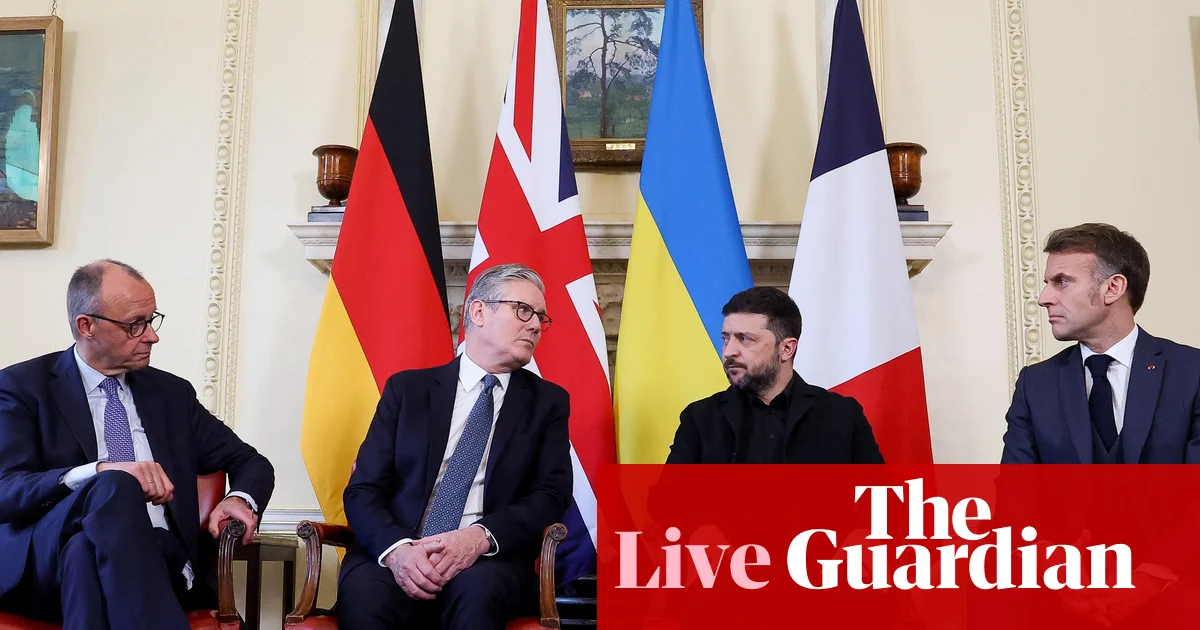
Writing after their talks in London, Volodymyr Zelenskyy has just posted a picture of the four leaders at 10 Downing Street with a caption:
“Guaranteeing real security is always a shared challenge and a shared effort. Thank you for your support!”
Starmer meets Zelenskyy: is a new peace plan possible? – podcast
As Keir Starmer hosts Volodymyr Zelenskyy in London, the Guardian’s Pippa Crerar and Kiran Stacey discuss what the ‘coalition of the willing’ can achieve.
Sombre tone of leaders’s comments reveals the scale of challenge they face — snap analysis
Jakub Krupa
The sombre tone of the opening remarks was highly telling: it’s clear that this was not merely another photo opportunity designed to merely convey solidarity with Zelenskyy, but they face urgent – increasingly so – issues that need to be resolved soon.
All four of them have made it very clear that they find themselves in a tricky position, but desperately need to keep the Americans on side – as difficult as it is. Not surprisingly, it was Zelenskyy who stressed this point the most.
But two other bits are also worth noting.
Macron’s swipe at the US administration that Europe has “a lot of cards in our hands” – a clear reference to Trump’s explosive comments to Zelenskyy in February – is also notable, and appears to show his frustration and desire – or demand – to be seen by the US and Russia as equal partners. It will be interesting if they can come up with something that would make Washington and Moscow stand up and take notice.
Also, Germany’s Merz was the only leader to explicitly flag his “scepticism” of some of the US proposals.
It may not sound entirely surprising given the current context and the evolution of his views on this in the past few months, but remember that this is a politician who for decades had been one of the most ardent advocates of the transatlantic relationship. He is now increasingly having his doubts about this Trump administration, it seems.
Germany ‘sceptical’ about some US proposals, Merz notes, but Europe ‘has cards in our hands,’ Macron says
Let me bring you the opening comments from the four leaders as they begin their talks at 10 Downing Street.
Opening, UK’s Starmer stresses the need for a just and lasting peace settlement for Ukraine.
Responding, Zelenskyy thanked Starmer for organising the meeting. He says it’s an important moment to discuss all “sensitive” issues.
He talks about the importance of unity between Europe, Ukraine, and the US. Zelenskyy says there are things “we can’t manage without Americans, … we can’t manage without Europe.”
Macron says “we all support Ukraine and peace,” as he says “we have a lot of cards in our hands”, as he talks about options for Europe and Russia’s increasingly suffering economy.
He talks the need to find a way to bring Europe and the US closer to agree the path forward.
Germany’s Merz says “these could be decisive” days “for all of us” on Ukraine.
He mentions the US-led peace talks, and says “we are and remain strongly behind Ukraine,” as he says “the destiny of this country is the destiny of Europe.”
He says he is “sceptical” about “some of the details coming in the documents from the US side,” and says that’s what he wants to talk with other leaders about.
And they will now continue the talks behind the closed doors.
