
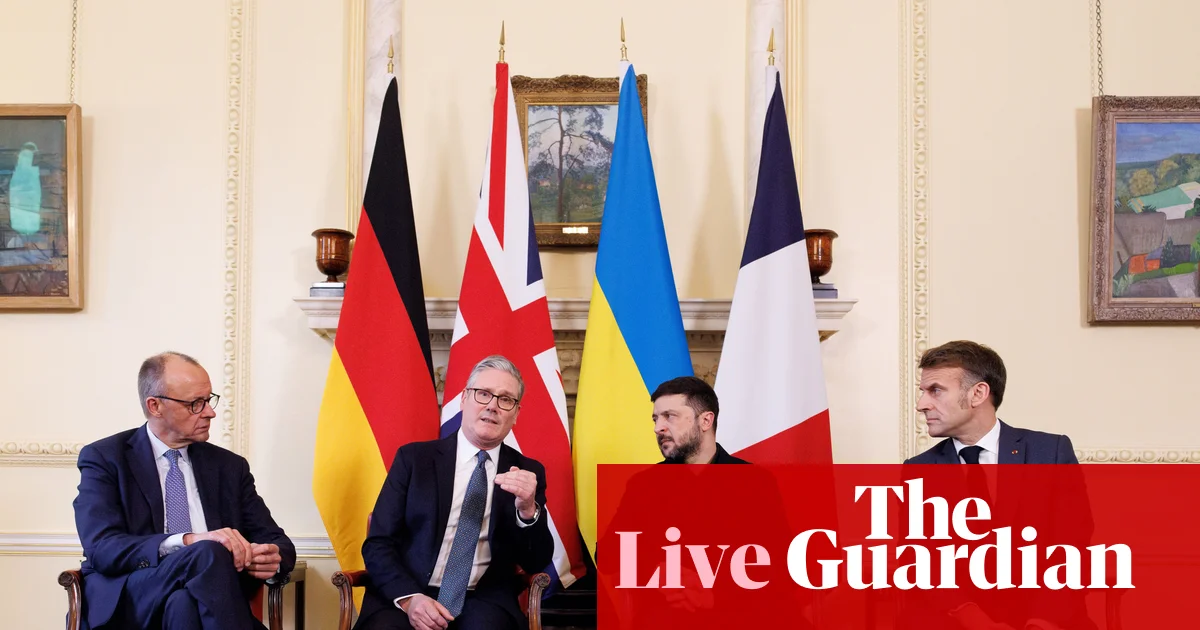
Merz, Macron, Starmer spoke with Trump about Ukraine, Germany confirms
The German government’s statement on the call confirmed that chancellor Merz joined France’s Macron and UK’s Starmer on a phone call with US president Trump.
They discussed “the state of talks” on ending the Ukraine war, agreeing that “intensive work on the peace plan is to continue in the coming days.”
The leaders also agreed that it was “a crucial moment” for Ukraine and for “common security in the Euro-Atlantic area.”
Key events
-
Summary
-
Merz, Macron, Starmer spoke with Trump about Ukraine, Germany confirms
-
Macron says he spoke with Trump, European leaders on Ukraine
-
27 governments call for Europe’s human rights laws to be ‘constrained’
-
Italy first country to win Unesco recognition for national cuisine
-
EU proposes exempting AI gigafactories from environmental assessments
-
European leaders expected in Berlin for talks on Ukraine next week – reports
-
Germany wants US to remain close partner despite changing nature of relationship, Merz says
-
‘We will hug again, fall in love again, hear our streets fill with laughter and music,’ Machado’s promise for Venezuela
-
María Corina Machado warns against taking democracy for granted
-
María Corina Machado expected in Oslo ‘in just few hours,’ daughter confirms
-
‘Let new age dawn’ in Venezuela, Nobel committee chair says
-
Chair of Nobel committee calls on Venezuela’s Maduro to step down
-
Maduro’s regime ‘systematically silences, harasses and attacks opposition’, chair of Nobel committee says
-
Nobel peace prize award ceremony about to get under way
-
‘Immense recognition to the fight of our people for democracy and freedom,’ Machado says
-
Coalition of the Willing meeting on Ukraine planned for Thursday, France says
-
María Corina Machado ‘safe’ and ‘will be’ in Oslo, Nobel committee says, but will miss prize ceremony
-
Trump’s comments ‘trying to break apart’ alliance between Europe and US, Pope Leo warns
-
Trump’s comments on Ukraine align with our view, Kremlin says
-
The US is not just Europe’s unwilling ally, but an adversary steeped in far-right ideology — opinion
-
Starmer, Frederiksen urge Europe’s leaders to curb ECHR to halt rise of far right
-
Morning opening: Zelenskyy’s election gambit
Summary
That’s it from us on this live blog. Here’s a recap of the main news of the day:
-
The leaders of France, Germany and the UK spoke with Donald Trump about Ukraine on Wednesday. In similar statements Emmanuel Macron, Friedrich Merz and Keir Starmer said they discussed “the state of talks” on ending the Ukraine war, agreeing that “intensive work on the peace plan is to continue in the coming days.” The leaders also agreed that it was “a crucial moment” for Ukraine and for “common security in the Euro-Atlantic area.”
-
Ukraine’s president Volodymyr Zelenskyy said his team would talk to US negotiators on Wednesday about the process of postwar reconstruction and economic development. This comes a day before urgent talks with 30 leaders in the Coalition of the Willing and amid plans to use frozen Russian assets to provide a $78bn loan to Kyiv.
-
There were unconfirmed reports that another meeting of European leaders on Ukraine is planned for Monday in Berlin, a week on from the latest summit in London.
-
German chancellor Friedrich Merz said he wanted the US to remain a partner of Germany despite a changing nature of their relationship, saying he would also defend his country’s record on migration when he next meets Donald Trump. This comes after Trump attacked Europe as “decaying” because of immigration. Merz said: “We are preparing ourselves for a change in transatlantic relations. But I would still like to see it as a partnership, and I hope that America sees it the same way in its relations with Europe and also with Germany.”
-
Volodymyr Zelenskyy has said he is ready to hold a wartime election within the next three months, if Ukraine’s parliament and foreign allies will allow it, after Donald Trump accused him of clinging on to power.
-
Pope Leo has criticized Trump’s comments about Europe. Without naming the US president the pope said: “Remarks that are made about Europe, also in interviews recently, I think, are trying to break apart what I think needs to be a very important alliance today and in the future.”
-
Venezuela’s opposition leader was awarded the Nobel peace prize in absentia at a ceremony in Oslo, Norway. María Corina Machado, has vowed to continue her struggle to free the country from years of “obscene corruption”, “brutal dictatorship” and “despair”. In a lecture delivered by her daughter, Ana Corina Sosa Machado, the former congresswoman and veteran pro-democracy campaigner pledged to continue leading Venezuela on its “long march to freedom”.

Shaun Walker
in Kyiv
A source in Ukraine’s SBU security service has provided footage of a drone attack on a Russian tanker allegedly belonging to the “shadow fleet” transporting Russian oil in defiance of sanctions.
The attack, earlier on Wednesday in the Black Sea, was a joint operation between the SBU and the Ukrainian navy, and used “Sea Baby” drones, small unmanned boats which can be fitted with a kamikaze explosive load, said the source.
The footage shows explosions on the tanker, named as the Dashan, which was flying under the flag of the Comoro Islands and was reportedly heading to the Russian Black Sea port of Novorossiisk. The Dashan has been put under British and European sanctions over suspicions it is part of the shadow fleet.
There was no independent confirmation of the video’s authenticity, nor was information available about the fate of the ship after the attack, but it appears to fit a pattern of Kyiv attacking shadow fleet ships as part of a strategy to deny Russia revenues from oil. Late last month, two other suspected shadow fleet ships were hit by Ukrainian drones in the Black Sea.
Dan Sabbagh
The British soldier who died in Ukraine on Tuesday has been named as L/Cpl George Hooley, 28, of the Parachute regiment.
Keir Starmer told the Commons on Wednesday that Hooley had died in a “tragic accident” away from the frontlines while watching a test of “a new defensive capability” with members of the Ukrainian military.
“His life was full of courage and determination,” Starmer said. “He served our country with honour and distinction around the world in the cause of freedom and democracy, including as part of the small number of British personnel in Ukraine.”
Britain has been coy about acknowledging the presence of its military personnel in Ukraine, a figure not thought to significantly exceed 100, partly because the UK is reluctant to allow their presence to be exploited by Russia for propaganda purposes.
Ukrainian forces were fending off an unusually large Russian mechanised attack inside the strategic eastern city of Pokrovsk, Kyiv’s military said on Wednesday, according to Reuters.
Here’s more from the Reuters report:
Russian troops have pushed forward in small infantry groups for months looking to capture the former logistics hub as a critical part of Moscow’s campaign to seize the entire industrial Donbas region.
Russia has claimed full control of Pokrovsk. Kyiv maintains that it holds the northern part of the city, where fierce urban battles have raged.
“The Russians used armoured vehicles, cars, and motorcycles. The convoys attempted to break through from the south to the northern part of the city,” Ukraine’s 7th Rapid Response Corps said in a statement on Wednesday morning’s assault.
A source in the 7th Rapid Response Corps told Reuters that Russia had deployed around 30 vehicles, making it the largest such attack yet inside the city.
The source added that previously Russia had deployed just one or two vehicles to aid troop advances.
Russian forces were attempting to exploit poor weather conditions but had been pushed back, the unit said on Facebook.
Footage posted by the unit depicted heavy vehicles in snow and mud, as well as drone attacks on Russian troops and explosions and burning wreckage.
Capturing Pokrovsk would be Russia’s biggest prize in Ukraine in nearly two years.
Late on Tuesday, Ukraine’s president rejected accusations from Donald Trump that he was using the war as an excuse to cling to power.
Volodymyr Zelenskyy rejected Trump’s intervention and said the question of elections “is a question for the people of Ukraine, not people from other states, with all due respect to our partners”.
The Ukrainian constitution prohibits elections to be held during wartime. However, Zelenskyy promised to explore avenues for holding a vote in the coming months. “Since this question is raised today by the president of the United States of America, our partners, I will answer very briefly: look, I am ready for elections.”
The US president previously attacked Zelenskyy for what he claimed was an attempt to avoid elections. In February, Trump called Ukraine’s president a “dictator” in light of postponed polls.
The Guardian’s Archie Bland wrote this explainer at the time on why Ukraine has not held elections since Russia invaded:
Ukraine is expected to give its latest peace proposals to US negotiators soon, Volodymyr Zelenskyy said on Wednesday, a day before he is to hold urgent talks with leaders in the Coalition of the Willing to end the war.
The French government said Ukraine’s allies — dubbed the “Coalition of the Willing” — will discuss the negotiations Thursday by video. Zelenskyy said it would include those countries’ leaders.
The Ukrainian president said his team would talk to US negotiators on Wednesday about the process of postwar reconstruction and economic development.
EU leaders will meet next week in an effort to sign off on a long-awaited European Commission proposal to funnel £78bn of the frozen assets into a “reparations loan” that would go to Kyiv next year. Though most EU countries support the plan, Belgium has put up strong resistance to it.
Writing on X, Zelenskyy suggested there could be news on an end to the war soon – but stressed it was key that any agreement would deter Russia from attacking Ukraine again in the future.
Zelenskyy said:
We are working very productively to guarantee future security and prevent a recurrence of Russian aggression. This week may bring news for all of us – and for bringing the bloodshed to an end. We believe that peace has no alternative, and the key questions are how to compel Russia to stop the killings and what specifically will deter Russia from a third invasion.
Jakub Krupa
That’s all from me, Jakub Krupa, but Fran Lawther is here to guide you through the late afternoon.
The UK version of the statement after the E3 call with Trump is very similar, and it reads:
“The Prime Minister spoke to the President of the United States, Donald Trump, the President of France, Emmanuel Macron, and the Chancellor of Germany, Friedrich Merz today.
The leaders discussed the latest on the ongoing US-led peace talks, welcoming their efforts to achieve a just and lasting peace for Ukraine, and to see an end to the killing.
Intensive work on the peace plan is continuing and will continue in the coming days.
They agreed that this was a critical moment – for Ukraine, its people and for shared security across the Euro-Atlantic region.”
The French version is almost identical, too.
Merz, Macron, Starmer spoke with Trump about Ukraine, Germany confirms
The German government’s statement on the call confirmed that chancellor Merz joined France’s Macron and UK’s Starmer on a phone call with US president Trump.
They discussed “the state of talks” on ending the Ukraine war, agreeing that “intensive work on the peace plan is to continue in the coming days.”
The leaders also agreed that it was “a crucial moment” for Ukraine and for “common security in the Euro-Atlantic area.”
Macron says he spoke with Trump, European leaders on Ukraine
France’s president Emmanuel Macron said he had held a phone call earlier on Wednesday US president Donald Trump to discuss the situation in Ukraine, Reuters reported.
“I was at the St Malo town hall for a phone call with some colleagues and President Trump on the question of Ukraine,” Macon said after arriving late at a public debate in the Brittany town on social media networks.
“We had about 40 minutes of discussion to advance on a subject that concerns all of us,” he said.
27 governments call for Europe’s human rights laws to be ‘constrained’
Rajeev Syal
Home affairs editor
The UK has joined some of Europe’s hardline governments in calling for human rights laws to be “constrained” to allow Rwanda-style migration deals with third countries and more foreign criminals to be deported.
Twenty-seven of the 46 Council of Europe members including the UK, Hungary and Italy have signed an unofficial statement that also urges a new framework for the European convention of human rights, which will also narrow the definition of “inhuman and degrading treatment”.
The statement follows a meeting of the council in Strasbourg on Wednesday as part of a push to change the way the laws apply in migration cases.
France, Spain and Germany are among those countries that have declined to sign the statement, instead putting their names to a separate, official declaration backed by all 46 governments.
The two separate statements are signs of deep divisions across Europe over how to tackle irregular migration, and whether to continue to guarantee rights for refugees and economic migrants.
The letter signed by 27 countries said that article 3 of the convention, which bans “inhuman or degrading treatment” should be “constrained to the most serious issues in a manner which does not prevent states parties from taking proportionate decisions on the expulsion of foreign criminals … including in cases raising issues concerning healthcare and prison conditions”.
It also argues that article 8 of the convention should be “adjusted” in relation to criminals so that more weight is put on the nature and seriousness of the offence committed and less on a criminal’s ties with the host country.
The rest of the 27 signatories are: Denmark, Albania, Austria, Belgium, Bulgaria, Croatia, the Czech Republic, Estonia, Finland, Iceland, Ireland, Latvia, Lithuania, Malta, Montenegro, the Netherlands, Norway, Poland, Romania, San Marino, Serbia, Slovakia, Sweden and Ukraine.
Italy first country to win Unesco recognition for national cuisine

Angela Giuffrida
in Rome
In other news, Unesco has officially recognised Italian cooking as a cultural beacon, an endorsement hailed by the far-right prime minister, Giorgia Meloni, whose government has put the country’s food at the heart of its nationalistic expression of identity.
The announcement, made on Wednesday during the UN cultural body’s assembly in Delhi, means Italian cuisine – from pasta and mozzarella to wine and tiramisu – will be inscribed on the coveted list of “intangible cultural heritage”.
Italy already has 21 other traditions on the list, including the art of Neapolitan pizza making and opera singing, and it is the first country to be recognised for its cuisine in its entirety rather than for a single tradition or recipe.
In a video message posted on her Instagram account within minutes of the announcement, Meloni said the news filled her with pride.
“We are the first in the world to receive this recognition, which honours who we are and our identity,” she said. “For us Italians, cuisine is more than just food or a collection of recipes. It’s much more than that: it’s culture, tradition, work and wealth.”
EU proposes exempting AI gigafactories from environmental assessments

Ajit Niranjan
Europe environment correspondent
Datacentres, AI gigafactories and affordable housing may be exempt from mandatory environmental impact assessments in the EU under a proposal that advances the European Commission’s rollback of green rules.
The latest in a series of packages to cut red tape calls for permitting processes for critical projects to be sped up and reducing the scope of environmental reporting rules for businesses.
The proposed overhaul would expand the list of strategic sectors to count datacentres, in line with the EU’s ambitions to become a global leader in AI, and affordable housing, to improve labour mobility. Member states would be free to decide whether such projects should be subject to environmental impact assessments.
Other parts of the simplification plan include repealing a hazardous chemical database that lists “substances of concern in products”; removing requirements on EU polluters to have authorised representatives in member states where they sell their products; and pushing the need for environmental management systems in farms and industry from the level of plants to that of companies.
You can read the full report here:
European leaders expected in Berlin for talks on Ukraine next week – reports
We have also had unconfirmed reports in the last half hour that another meeting of European leaders on Ukraine is planned for Monday in Berlin, a week on from the latest summit in London.
We will keep an eye on this and bring you the official confirmation if/when we get it.
