
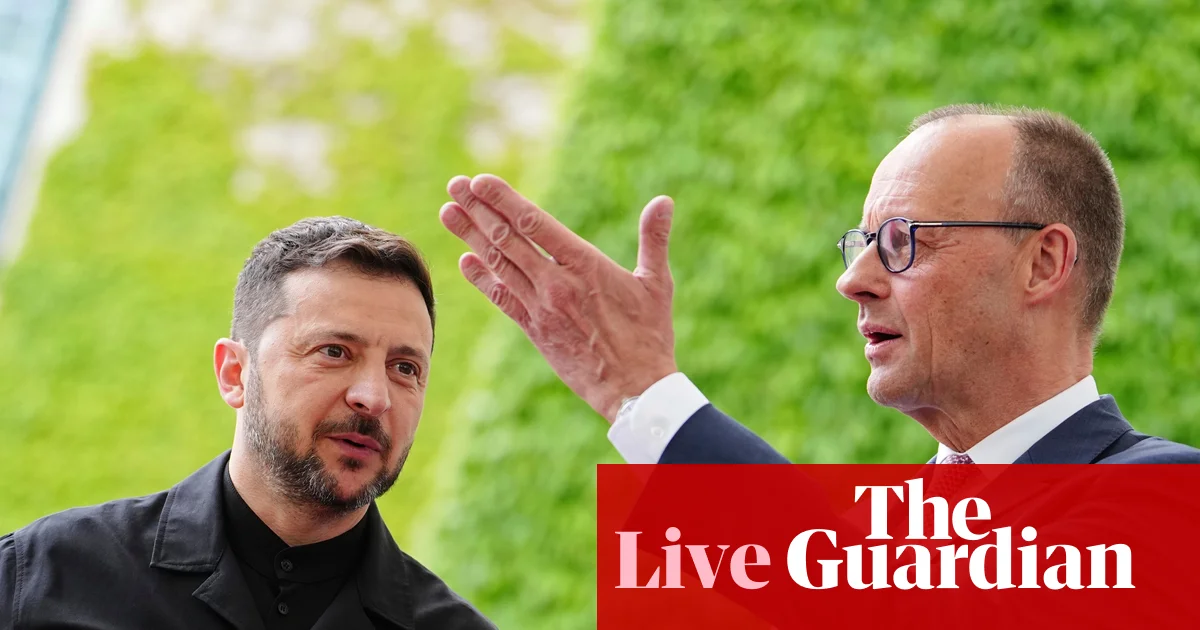
Merz talks with Zelenskyy on anti-corruption efforts, push for peace talks with Russia
German chancellor Friedrich Merz spoke with Ukrainian president Volodymyr Zelenskyy this morning, discussing the latest corruption allegations against (now former) members of the Ukrainian government.

Merz’s spokesperson, Stefan Kornelius, said Zelenskyy “informed (Merz) about the corruption investigations against members of his government who have since resigned, pledging full transparency and long-term support for independent anti-corruption agencies,” and “further swift measures to regain the trust of the Ukrainian people, European partners, and international donors.”
Merz, in turn, “emphasises the German government’s expectation that Ukraine would vigorously pursue the fight against corruption and further reforms, particularly in the area of the rule of law.”
The leaders also spoke about the need to “increase pressure on Moscow to compel Russia to enter into serious negotiations” on a peace settlement, notedly referencing “a more effective use of Russia’s immobilised state assets.”
The pair also spoke about continued aid for Ukraine, helping with air defence and energy infrastructure, and the growing number of young Ukrainian men seeking to leave the country for the European Union.
Key events
EU ‘must stop sending money of European citizens to Ukraine,’ Hungarian minister says
Hungarian foreign minister Péter Szijjártó was quick to jump on the latest corruption allegations in Ukraine, arguing that the EU should stop supporting the country.
Hungary has long been critical of the bloc’s support for Ukraine, repeatedly calling for urgent reengement with Moscow to end the war, seeking to delay further sanctions on Russia, and engaging with Russian counterparts outside EU formats.
In a post on X, Szijjártó – who regularly visits Russia – said:
“For years now, the functioning of the Ukrainian state has been financed with the money of European citizens.
Meanwhile, corruption is out of control in Ukraine, so it’s no surprise that no one has ever seen a clear accounting of how the EU funds were actually spent. And what does Brussels want to do now? Send even more money to Ukraine, to @ZelenskyyUa, whose closest circle has just been exposed as running a major corruption network.
It’s time to put an end to this madness. We must stop sending the money of European citizens to Ukraine!!!”
Similar arguments were put forward by the Russian embassy in the Netherlands, among others.
Merz-Zelenskyy call on corruption shows concern from European partners – snap analysis

Jakub Krupa
The Merz-Zelenskyy call is significant as show the level of concern among some of Ukraine’s closest allies about the reported corruption investigation and Kyiv’s determination to fight corruption – an issue also highlighted in a recent EU progress report.
The European Commission’s daily midday briefing is about to get under way in the next few minutes, and it’s more likely than not that we will hear from them on this very point, too.
Separately, the latest corruption allegations about the government in Kyiv also meant Merz could face some criticism domestically, particularly from the far-right Alternative für Deutschland, over his continued support for Ukraine, so he needed to send a clear message here: highlighting his serious concern and his strong demand for Kyiv to urgently act on this issue.
They will be hoping in Berlin that this call achieves just that.
Merz talks with Zelenskyy on anti-corruption efforts, push for peace talks with Russia
German chancellor Friedrich Merz spoke with Ukrainian president Volodymyr Zelenskyy this morning, discussing the latest corruption allegations against (now former) members of the Ukrainian government.
Merz’s spokesperson, Stefan Kornelius, said Zelenskyy “informed (Merz) about the corruption investigations against members of his government who have since resigned, pledging full transparency and long-term support for independent anti-corruption agencies,” and “further swift measures to regain the trust of the Ukrainian people, European partners, and international donors.”
Merz, in turn, “emphasises the German government’s expectation that Ukraine would vigorously pursue the fight against corruption and further reforms, particularly in the area of the rule of law.”
The leaders also spoke about the need to “increase pressure on Moscow to compel Russia to enter into serious negotiations” on a peace settlement, notedly referencing “a more effective use of Russia’s immobilised state assets.”
The pair also spoke about continued aid for Ukraine, helping with air defence and energy infrastructure, and the growing number of young Ukrainian men seeking to leave the country for the European Union.
France pays tribute to victims on 10th anniversary of 13 November 2015 terror attacks
Meanwhile, over in Paris, France pays tribute to the victims of the 13 November 2015 terror attacks today in which 130 people were killed.
French president Emmanuel Macron is taking part in events commemorating the 10th anniversary of the attack, as is the country’s prime minister Sébastien Lecornu, and other current and former officials, including Paris mayor Anne Hidalgo former president François Hollande.
Row with Beijing that threatened global car production is ‘wake-up call’ to west, Dutch minister says

Lisa O’Carroll
A bitter battle over the future of a Chinese-owned chipmaker in the Netherlands that threatened to cripple the global car industry is a “wake-up call to Europe and the west”, the minister at the heart of the row has warned.
The six-week standoff between the EU and Beijing over Nexperia and its vital supplies of automotive semiconductors has served up a sobering lesson to world leaders over their dependency on China, says Vincent Karremans.
The Dutch economy minister says he has no regrets about the tussle and would not change his actions even with the benefit of hindsight. “There’s a lot of interest in exactly what happened,” he says. “It’s like an economic thriller.”
Detailing for the first time how the trade war unfolded, he recalls high-level exchanges with his German counterpart, the car industry and the US, as well as conversations with critical intelligence that he claims showed Nexperia was moving parts of its physical operations in Hamburg to China.
Jakub Krupa
As the Dutch debate continues – with JA21 leader Joost Eerdmans confirming his party’s readiness to join talks about a centre-right government – let me bring you a different story on the Netherlands, and their recent spat with China over car chips.
Ukraine will need to sit down for peace talks ‘sooner or later,’ Kremlin says
Meanwhile, the Kremlin argued that Ukraine would have to negotiate with Russia “sooner or later” and that Kyiv’s negotiating position was getting worse by the day, Reuters reported.
Moscow has accused Ukraine of refusing to engage in peace talks, but Kyiv says Moscow’s terms to end the war are unacceptable and tantamount to asking it to surrender.
Kremlin spokesperson Dmitry Peskov told reporters that Russia remained open to a political and diplomatic settlement, but in the meantime would continue its war against Ukraine.
“ …the Ukrainian side should know that sooner or later it will have to negotiate, but from a much worse position. The position of the Kyiv regime will deteriorate day by day,” he said.
Complex political negotiations needed to form next Dutch government, early talks show
Jakub Krupa
If you’re reading all this and think it could take some time to sort out a working coalition – you’re right.
Ideally, Jetten would want to form a broad coalition of D66 (26 seats), Yeşilgöz-Zegerius’s VDD (22), the left-wing GroenLinks–PvdA (20), and centre-right CDA (18). This would get him a clear majority in the parliament with 86 out of 150 seats in the parliament, but VDD is not keen on teaming up with the left.
The most obvious alternative would be to form a centre-right coalition with D66, VDD, CDA, and hard-right JA21 (9), but that would only get him to 75 seats, opening the new government to all sorts of political risks.
The next stage of exploratory talks – led by D66 and CDA, as they develop their proposed agenda in five key areas by 9 December – will allow for talks to continue to see what can be done here.
The outgoing caretaker prime minister Dick Schoof joked on the election day that he just wanted to be replaced before August next year when he intends to run the Sydney marathon.
It may not take quite that long, but judging by early comments from party leaders this morning – there’s a fair bit more to go before we get a coalition here.
In a sign of potential trouble for Jetten, Dilan Yeşilgöz-Zegerius of the VVD party – which D66 hopes to get on their side in the future government – says her preferred coalition would be on the centre-right, seemingly once again ruling out a coalition with the left-wing GroenLinks–PvdA party.
She lists the economy, defence, stricter immigration and asylum laws, and public finances as the party’s priorities.
Netherlands ‘yearns for new era’ under new government, D66’s Jetten says, but no coalition talks breakthrough yet
Opening the debate, Jetten says that “millions of Dutch people have chosen cooperation and optimism” over “bickering and stagnation” of the previous right-wing government, as he says the Netherlands “yearns for a new era” of “stability and decisiveness.”
He repeats his key policy focus areas: housing, climate change, migration, and the economy.
He says the voters expected parties to “not just look at the differences, but cooperate where possible” to help voters “regain confidence in the power of politics to improve life.”
Jetten says the party feels “great responsibility” to form the next government, and calls for the appointment of two “informateurs” from his party, D66, and the centre-right CDA to push ahead with the government forming talks.
But he concedes that as there is no clear coalition emerging yet, the talks will need to continue, with the next deadline in early December.
But speaking after him, populist PVV leader Geert Wilders goes on the attack, saying the two parties proposed to lead the coalition talks have no majority and are going to “waste time”, as he insists that a right-wing government should be formed instead.
He says that if his party is not blocked from the next administration, a new right-wing government could be formed even before Christmas.
Dutch parliament in sitting to discuss government-forming process
The new Dutch parliament is now in sitting.
New lawmakers were formally sworn in yesterday, and they are back this morning to discuss the next steps in the government-forming process.
Speaker Martin Bosma is opening the sitting, and we’re going to hear from all the party leaders, including the likely next prime minister Rob Jetten.
Reparation loan on Russian frozen assets ‘important instrument in bringing peace,’ Zelenskyy says
Ukraine’s Volodymyr Zelenskyy also commented on the issue of Russian frozen assets this morning, telling EU leaders it would be “a big-big loss” for Russia “if we can get this money in any way, be it a loan insured by other countries or any other way.”
“If we can have these 140-160bn, this will be a big loss for Putin and his circle of people. You know that it’s their money. And that’s why, for them, it’s really destabilising the system, their clique,” he said.
He also said Kyiv would use the money “not only for weapons,” but also to produce other equipment.
“This (would) be an important signal for Russia: look, if you continue, you will lose from 35 to 80 billion next year on energy trade (depending on how sanctions will work), and plus 140 in frozen assets. This is an important instrument in bringing peace,” he stressed.
‘Important we keep supporting Ukraine,’ Dutch finance minister says
Separately, Dutch finance minister Eelco Heinen said the EU needed to listen to Belgium’s concerns about using Russian frozen assets to help Ukraine, but insisted it was important the bloc continued its support for Kyiv.
“I think it’s important that we keep supporting Ukraine. So that’s what I’m fighting for here, that we have to keep the money going through Ukraine so it can be stay afloat – the economy and also their military – in order to fight the aggression that Russia is putting on Ukraine,” he said.
Asked about the corruption scandal, he said:
“Fighting corruption is a continuous effort that Ukraine has to do, and I’m keep having this dialogue with them as well, that they have to fight corruption, and it’s also part of the conditionality we put on packages we design for Ukraine.”
Morning opening: How to fund Ukraine next?
Jakub Krupa
EU finance ministers are meeting in Brussels this morning to discuss economic and financial agenda of the bloc, including the increasingly urgent question of funding for Ukraine.
Ukraine’s president Volodymyr Zelenskyy said in an interview with Bloomberg, published this morning ($), that the country’s survival relied on getting more funds from allies.
“I hope, God bless, we will get this decision,” he told Bloomberg Television. If not, “We will have to find an alternative, it’s a question of our surviving. That’s why we need it very much. And I count on partners.”
The European Commission still hopes to convince the member states – and Belgium, in particular, as it continues to bloc the proposal amid legal fears – to go ahead with a €140bn reparations loan based on frozen Russian assets.
Commission president Ursula von der Leyen insisted this morning that it would be “the most effective way to sustain Ukraine’s defence and its economy.”
A final decision on the issue has been postponed until the EU leaders’s summit in December, with the funding needed early next year.
But the talks come at a tricky moment for Kyiv, as Zelenskyy had to move to contain growing public outrage in Ukraine over a corruption scandal in the energy sector, firing two ministers who are accused of involvement in a large-scale bribery scheme.
Danish economic affairs minister Stephanie Lose was asked about her reaction to the scandal, and insisted that there was determination to continue supporting Ukraine.
“Of course, Ukraine will have to continuously work with reforms, strengthening all parts of their society (and) that also applies to anti-corruption … but there shouldn’t be any doubt that there’s a strong European support behind Ukraine,” she said.
Let’s see what comes out of today’s meeting.
Separately, I will be keeping an eye on the Netherlands where the parliament meets to discuss potential ways ahead in the government formation process, the Italy-Albania consultations in Rome giving us the latest chance to enjoy the brilliant Meloni-Rama dynamics, and a number of high-level meetings across Europe, including Nato’s Mark Rutte’s visit to a German airbase.
Lots for us to cover.
It’s Thursday, 13 November 2025, it’s Jakub Krupa here, and this is Europe Live.
Good morning.
