
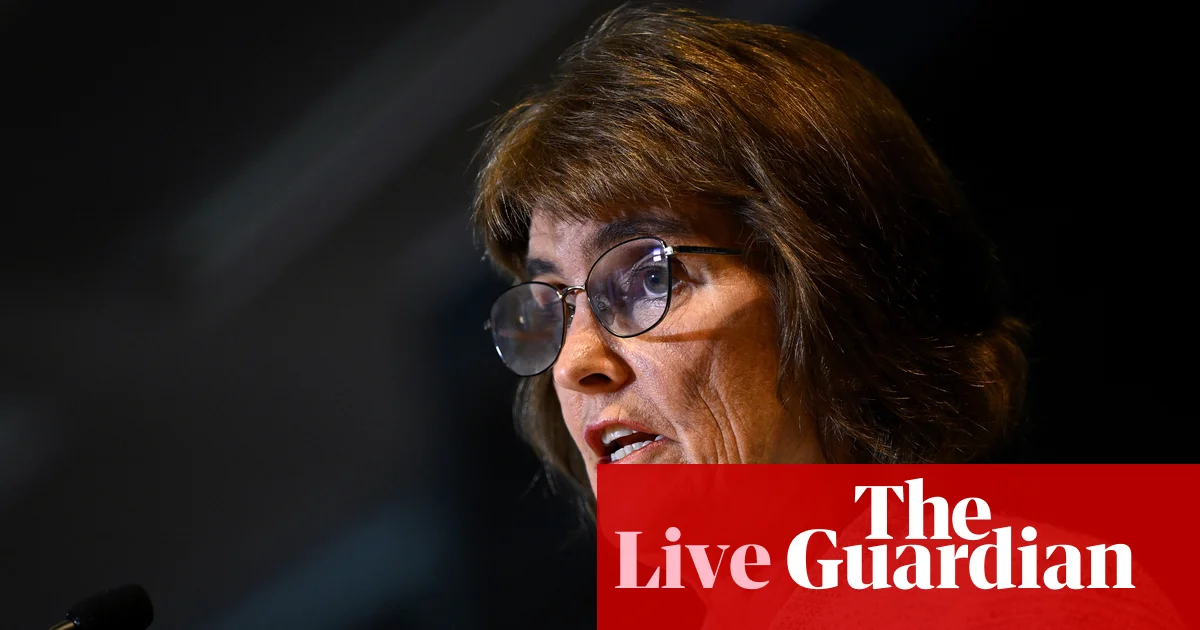
PM dismisses ‘rhetorical flourishes’ from Ley after she claims Labor’s ‘reckless’ spending drove RBA rates call
Staying on that rate hold, the Coalition leader, Sussan Ley, says Australian households have been “denied a Christmas rate cut” because of “Labor’s reckless spending”.
Anthony Albanese says he’ll skip past “some of the rhetorical flourishes” in the question.
He goes through the support the government has provided on cost of living, and does a political “compare and contrast”.
They (the Coalition) oppose the energy bill relief. They oppose the tax cuts. They oppose the pay rises for low income workers. They opposed fee-free Tafe.
Key events
Better for RBA board to change its mind than ‘stick to its guns’, Bullock says
Bullock said the RBA is not “wedded religiously to a particular path” on interest rates:
What we are trying to do is very actively analyse the data as it comes through. We’re not backward looking. We take the data that we’ve got, we use that as a starting point, and then we attempt to forecast, using our models, using our judgment about what the outlook might look like.
I would have thought, quite frankly, that it would be worse for the bank to stick to its guns rather than change its mind in the face of new information.
Bullock: ‘Anything’s possible’ as to where rates go in future
Asked if it’s possible interest rates could go up or down in the future, Bullock said: “Anything’s possible.”
She continued:
All I would say is that I think we’re at the right spot we need to be at the moment, and we can respond where the risks arise.
So if the risks turn out to be on the downside, which some people have suggested on the employment side, we’re able to respond. Likewise, if the risks are on the upside, we’re able to respond. But I think at the moment, we think we’re where we need to be.
RBA still chasing inflation target of 2.5%, Bullock says
Bullock said that the RBA is still targeting 2.5% as the official inflation target:
The board is very definitely targeting 2.5%. Just below three is not good enough for the board.
And I think again, when you take those inflation forecasts at face value with the one more interest rate cut in there, what that’s telling you is that it’s really an interesting question about whether there’s many more rate cuts left to come.
The bank’s updated forecasts, predicated on market bets of a cut by the end of 2026, show core and headline inflation were no longer expected to gradually return to 2.5%, the middle of the RBA’s preferred range, but instead bump up then drop back to 2.6% by the end of 2027.
Unemployment should stay ‘reasonably stable’: Bullock
Bullock said that the RBA expects that the unemployment rate will remain “reasonably stable from here on in”.
Asked by a reporter if there was any risks of stagflation, she said:
I think, at the moment, we’re still confident that inflation is going to come down, and we’ve got employment at a pretty good place.
RBA board did not consider rate cut, governor says
Bullock said the RBA did not consider cutting the cash rate this time round.
We basically just talked about holding and the reasons to hold, and then discussed strategy moving out, depending on what way.
What I think I highlighted in my opening statement … was that unemployment went up a little bit more than we expected, but so did inflation, so we’re being a little bit cautious here.
RBA governor says ‘temporary factors’ behind higher inflation not expected to continue
The RBA governor, Michele Bullock, is speaking now about the bank’s decision to leave the official interest rate on hold.
Bullock said:
Inflation in the September quarter was higher than we were expecting in our previous forecasts.
We think some of this was driven by temporary factors such as travel costs, council rates and fuel, and we don’t expect some of these to continue. We are, however, taking signal from stronger price increases that may suggest more inflationary pressure in the economy than we thought before.
In particular, the cost of new dwellings and market services both increased by more than expected, and inflation in these components tends to be more persistent at the same time, the unemployment rate has gone up.
Question time ends
Tim Wilson tries again to get a question in, but Albanese stares him off and ends question time for the day.
Not before Jason Clare gave his best impression of a race commentator during a dixer on the 20% Hecs debt discount.
The race that stops the ration has been run and won and there are a few lucky winners across the country. But in the next few weeks there won’t just be a few winners, there’ll be millions of them. And that’s ‘cause we’re cutting student debt by 20%.
Clare O’Neil pushes back on claim regional areas not getting fair share of housing funding
Andrew Gee is up again with a second question, but not before Tim Wilson tries to get in with one of his own at the dispatch box. But Milton Dick tells him to sit down.
Gee tells the housing minister his electorate and other country communities are not getting their fair share of national housing funding.
The housing minister, Clare O’Neil, says the housing programs have an “important regional dimension”.
The home ownership statistics in your part of the world are looking pretty good, I think there’s about 1,300 people in the member for Calare’s electorate who have got into first home ownership with our backing.
O’Neil says she’d be “pleased” to talk to Gee and his community further.
Albanese asked whether help-to-buy scheme will push house prices up
Liberal MP Mary Aldred is up next – and goes on the attack on housing. Housing prices grew at a faster rate in September than at any other time in the last two years, and she says the government’s help-to-buy scheme will “push house prices up by 6.6% in 2026 for several years after that”, while interest rates didn’t go down today.
Anthony Albanese tests Aldred and says she should write to all her constituents who are eligible for the help-to-buy scheme.
He then goes down a familiar path, criticising the opposition for not having a housing minister, saying, “Apparently, up to 2022 everything was hunky dory”.
The opposition stands up on a point of relevance, but Milton Dick says the question was broad, and tells Albanese to remain relevant. Albanese says:
Before May 2022 there were houses being built everywhere, there were social homes and people were getting into public housing. Rentals apparently were coming down under them. It’s all nonsense because it’s all about supply. And what we have done is concentrate on supply.
Infrastructure minister says NSW government still weighing up major work on Great Western Highway
Back to the crossbench, Nationals turned independent MP Andrew Gee asks whether the government will commit to turning the Great Western Highway into a genuine expressway to Sydney?
Gee represents the seat of Calare which stretches from Lithgow near the NSW Blue Mountains to Dubbo.
The infrastructure minister, Catherine King, says this major work has to be done with the support of the NSW government who are still considering the project.
She then accuses the former government of promising and not delivering on projects in the region, and lists other infrastructure projects Labor has funded.
We are investing in infrastructure in Calare, but we do it properly, and we do in a way that we can deliver … properly planned and properly costed, unlike those opposite.
Shadow treasurer’s question on inflation is dishonest or lacks understanding, Chalmers says
Ted O’Brien asks the treasurer again if he’ll “stop his spending spree”, with the Reserve Bank predicting that inflation won’t return back into the target band of 2-3% until 2027.
Jim Chalmers says O’Brien hasn’t “thought through his question”.
If he was talking about the forecasts he would point out that the Reserve Bank has revised down the contribution made by public spending to the economy. Either he doesn’t understand that, which is troubling, or he does understand that and he’s trying to be dishonest about it, equally troubling.
Chalmers adds that while there are inflation pressures in the economy, inflation is expected to moderate in the December quarter.
What governor (Michele) Bullock said last week when she was asked about the fiscal position … (she said) we have relatively low debt compared to other countries, relatively low debt to GDP ratios … and the most recent deficit in fact is quite small as well.
Independent Kate Chaney asks Burke about ‘huge loopholes’ in environment law reforms
Independent Kate Chaney throws another question to the environment minister on the environment protection reforms.
She says the current reforms are at risk of being undermined by “huge loopholes”:
Under the reforms, projects can pay for environmental projects into a central offsets fund, but in New South Wales, Queensland, the Pilbara and overseas, these funds have consistently failed to deliver real environmental outcomes.
Will the government consider amendments to put stronger safeguards around this offsets fund so it actually delivers for nature?
Tony Burke (again, representing the environment minister, Murray Watt) says the new laws shift regulations around offsets from no net loss, to introducing a “net gain”.
That’s a significant shift that happens in terms of what offsets are aiming to be able to deliver for the environment.
Burke says an independent restoration contributions holder will also be established to manage offset funds and ensure that “net gain” is delivered.
A little earlier, just before question time, Michael McCormack brought his binoculars and best commentator’s voice to the house.
You can see his 90-second speech in all its glory here (and I promise it’s worth the watch!)
Bowen says Nationals ‘out of touch’ after deputy’s question on aluminium smelter ignores Rio Tinto’s mention of renewables
The deputy Nationals leader Kevin Hogan is up next, and asks about the future of the Tomago aluminium smelter. He quotes Rio Tinto’s CEO who said “unfortunately all market proposals received show future energy prices are not commercially viable”.
The energy minister, Chris Bowen, says Hogan should have read the full quote – “there is not a full stop (there), there’s a comma,” he says. The rest of it, Bowen says, is: “and there is significant uncertainty when the renewable projects will be available at the scale we need”.
What does that mean? Bowen says:
Rio and Tomago were arguing for more renewables not less. They are not blaming renewables, they’re calling us to do more and we agree with them. The opposition are the ones out of touch.
PM dismisses ‘rhetorical flourishes’ from Ley after she claims Labor’s ‘reckless’ spending drove RBA rates call
Staying on that rate hold, the Coalition leader, Sussan Ley, says Australian households have been “denied a Christmas rate cut” because of “Labor’s reckless spending”.
Anthony Albanese says he’ll skip past “some of the rhetorical flourishes” in the question.
He goes through the support the government has provided on cost of living, and does a political “compare and contrast”.
They (the Coalition) oppose the energy bill relief. They oppose the tax cuts. They oppose the pay rises for low income workers. They opposed fee-free Tafe.
Chalmers says RBA decision to keep rates on hold ‘widely expected’
As we brought you a moment ago, the Reserve Bank has kept rates on hold.
In a dixer (an easy question from a government backbencher to a minister), Jim Chalmers says that households would have liked to have seen a rate cut today, but the decision was widely expected.
This decision was widely anticipated by markets and widely expected by economists.
Now, it is the case that inflation is much lower than we inherited from those opposite, and that has given the Reserve Bank the confidence to cut interest rates three times already this year.
Shadow treasurer says Labor does not take responsibility for rises in inflation
Jumping back into question time, the shadow treasurer, Ted O’Brien, asks Jim Chalmers again about the rising cost of living. O’Brien says the government takes the glory when inflation goes down, but doesn’t take responsibility when it goes up.
Chalmers says he “shares” the win when inflation goes down with the Australian public (cue lots of heckling from the opposition).
He says the government takes responsibility for the difficulties in the economy after the Covid pandemic and for getting real wages moving again.
We’re actually doing something about it now, when Australians are under pressure, in this building. This House of Representatives, has two choices to do something about it in the most responsible way that we can, which has been the approach of this Albanese Labor government, or to oppose that cost of living help and to take the most irresponsible course of action, which is what the course that those opposite have adopted.
RBA holds official interest rate at 3.6%

Luca Ittimani
The Reserve Bank has left the official interest rate on hold after a surprise jump in inflation, in a widely expected decision.
The RBA’s monetary policy board on Tuesday left the cash rate at 3.6%, where it has sat since August. Economists and banks overwhelmingly expected no change.
The central bank has cut interest rates three times in 2025, easing pressure on mortgage holders and fuelling rapid house price rises.
Core inflation rose to 3% – the top of the RBA’s preferred range – in September, the first acceleration of the underlying measure since 2022, the Australian Bureau of Statistics reported on Wednesday.
Independent Helen Haines questions new environment bill’s commitments to community consultation
Over to the crossbench, and independent MP Helen Haines says poor community consultation under the current the Environment Protection and Biodiversity Conservation Act is eroding social licence. She asks if the minister will commit to “best practice community engagement standards” under the new EPBC bill.
Tony Burke (representing the environment minister, Murray Watt, who sits in the Senate) says he understands Watt has spoken to Haines about community consultation.
Burke adds that standards can’t be established until the bill is passed.
Soon we will be making draft standards available for matters of national environmental significance and for offsets. Also the first Nations engagement standard and data and compliance. None of these standards actually have force until they have legislation to bounce off effectively, to launch from.
