
Supreme court rules Texas redistricting may proceed
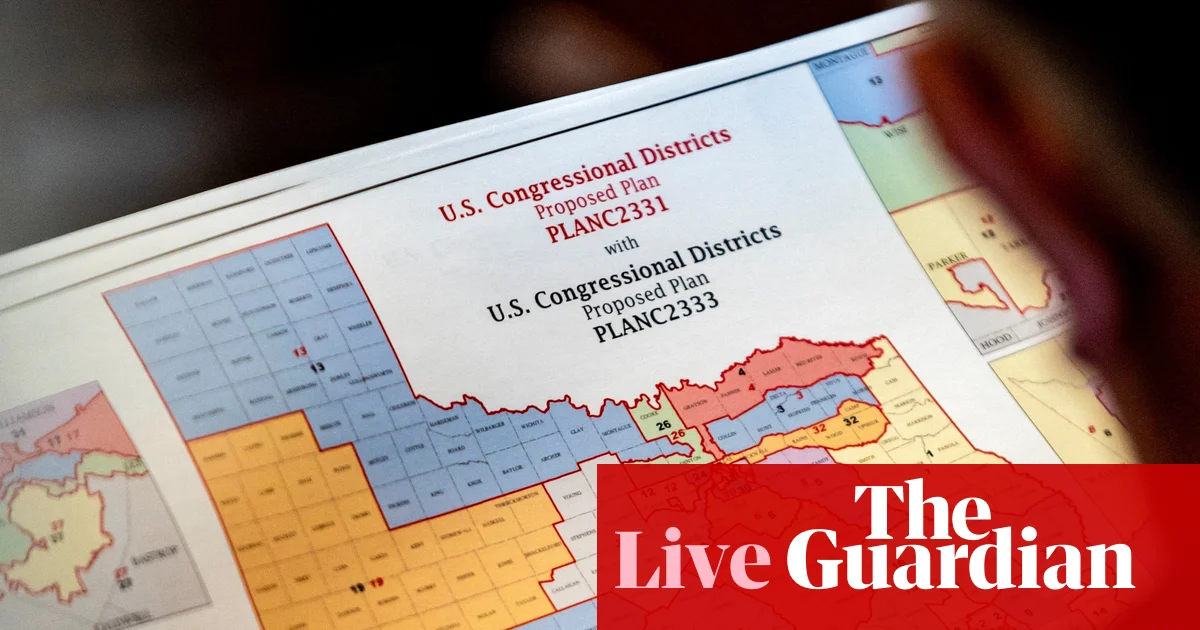
The Supreme Court will allow Texas to use a congressional map redrawn to favor Republicans in 2026. The ruling will impact elections as soon as the March primaries.
Texas redrew its congressional map this summer as part of an effort Donald Trump initiated to protect Republicans’ slim majority in the House ahead of the 2026 midterm elections. The effort kicked off a nationwide redistricting battle that saw California voters respond by voting to redraw their state’s congressional map as well.
Today’s Supreme Court ruling responds to an emergency request for a decision from Texas because candidates have until 8 December to file to run ahead of the March primaries.
Key events
US Southern Command released unclassified footage of the boat strike, showing a vessel speeding through the waters before going up in flames.
US forces strike another alleged drug trafficking boat, killing four people
US forces have struck another alleged drug trafficking boat in the eastern Pacific, killing four men.
The US Southern Command released a statement on X saying the strike came at the direction of defense secretary Pete Hegseth.
The statement says:
On Dec. 4, at the direction of @SecWar Pete Hegseth, Joint Task Force Southern Spear conducted a lethal kinetic strike on a vessel in international waters operated by a Designated Terrorist Organization. Intelligence confirmed that the vessel was carrying illicit narcotics and transiting along a known narco-trafficking route in the Eastern Pacific. Four male narco-terrorists aboard the vessel were killed.
Pam Bondi celebrates justices’ ruling in favor of Texas Republicans
Trump’s attorney general Pam Bondi also celebrated the decision. Bondi said federal court had “no right to interfere with a state’s decision to redraw legislative maps for partisan reasons”.
Writing on X, she added: “A federal district court ignored that principle two weeks ago, and the Supreme Court correctly stayed that overreaching decision tonight. Congratulations to Texas for advancing the rule of law, my Solicitor General John Sauer, and our team of lawyers for their excellent brief supporting Texas in this important case.”
As Rachel Leingang reported, courts now cannot stop maps drawn for partisan reasons, but they can intervene if maps are racially gerrymandered. And that was the basis of the lower court’s decision as referenced in my earlier post.
Catch up on that full report here:
Texas attorney general hails supreme court decision
Ken Paxton, the Texas attorney general, has welcomed the supreme court decision in favor of the state’s Republican party.
In a statement carried by the Associated Press, Paxton said the order “defended Texas’s fundamental right to draw a map that ensures we are represented by Republicans.”
“Texas is paving the way as we take our country back, district by district, state by state,” he added. “This map reflects the political climate of our state and is a massive win for Texas and every conservative who is tired of watching the left try to upend the political system with bogus lawsuits.”
Today’s supreme court decision overrules an order by a panel of three federal judges in November, who had said the state could not use the 2025 maps because they are probably “racially gerrymandered”.
At the time, Judge Jeffrey Brown wrote: “The public perception of this case is that it’s about politics. To be sure, politics played a role in drawing the 2025 map. But it was much more than just politics. Substantial evidence shows that Texas racially gerrymandered the 2025 map.”
The Guardian’s Rachel Leingang reported in November:
Typically, redistricting happens after a new decade’s census results. Maps are often fought over, inviting lawsuits that can take years to resolve. In some states, the process is done by lawmakers, while in others, by independent bodies. Courts now cannot stop maps drawn for partisan reasons, but they can intervene if maps are racially gerrymandered.
Brown pointed to Texas lawmakers’ responses to the justice department. Lawmakers initially resisted the idea of redrawing maps for purely partisan reasons, but moved forward after the Trump administration “reframed” the idea of redistricting around racial makeup.
A July letter from the head of the department’s civil rights division, Harmeet Dhillon, made the “legally incorrect assertion” that four of Texas’s congressional districts were unconstitutional. She threatened legal action if the state did not redraw these “coalition districts”, where no single racial group made up a majority of voters – “a threat based entirely on their racial makeup”, Brown wrote.
“Notably, the (justice department) letter targeted only majority-non-white districts,” the decision says. “Any mention of majority-white Democrat districts – which (the justice department) presumably would have also targeted if its aims were partisan rather than racial – was conspicuously absent.”
The legislature and governor’s office then followed suit on these demands from the justice department, Brown said, noting statements made by local officials on their reasoning.
“The governor explicitly directed the legislature to redistrict based on race,” Brown wrote. “In press appearances, the governor plainly and expressly disavowed any partisan objective and instead repeatedly stated that his goal was to eliminate coalition districts and create new majority-Hispanic districts.”
The supreme court, which has a 6-3 conservative majority, issued its ruling in an unsigned order. Its three liberal justices dissented, Reuters reports.
In a brief opinion explaining the decision, the court writes: “The district court improperly inserted itself into an active primary campaign, causing much confusion and upsetting the delicate federal-state balance in elections.”
While acknowledging the political aims of Texas to benefit the Republican party, the opinion also said the lower court mistakenly did not fault the new map’s challengers for not themselves producing “a viable alternative map that met the state’s avowedly partisan goals”.
The ruling comes amid a nationwide battle about the redrawing of electoral maps. Republicans and Democrats have been engaged in a war in legislatures and courts to narrow the political battlefield of 2026 before a single vote is cast.
Here’s more on this battle from the Guardian’s George Chidi and Andrew Witherspoon:
Grand jury refuses a second indictment of Trump opponent Letitia James
A grand jury has declined to re-indict Letitia James, the New York Times and Associated Press report, citing sources familiar with the matter.
A Virginia grand jury chose not to indict James, a Trump critic, on a mortgage fraud charge the Trump administration has sought to revive. The president has sought to prosecute James since returning to office in January, following a years-long civil case James had overseen investigating Trump for overstating his wealth.
Here’s more of our past coverage of James:
Supreme court rules Texas redistricting may proceed
The Supreme Court will allow Texas to use a congressional map redrawn to favor Republicans in 2026. The ruling will impact elections as soon as the March primaries.
Texas redrew its congressional map this summer as part of an effort Donald Trump initiated to protect Republicans’ slim majority in the House ahead of the 2026 midterm elections. The effort kicked off a nationwide redistricting battle that saw California voters respond by voting to redraw their state’s congressional map as well.
Today’s Supreme Court ruling responds to an emergency request for a decision from Texas because candidates have until 8 December to file to run ahead of the March primaries.
Mark Warner, a Democrat from Virginia and the vice chair of the Senate Intelligence Committee, called footage of a US attack on a Venezuelan boat “very disturbing.”
“We all know that our country’s record of interventions in the Caribbean and Central America and South America over the last 100-plus years hasn’t been a perfect record,” Warner said.
He added that all of Congress should see the video footage, and asked for the Trump administration to share additional information about the strikes.
National guard troops may temporarily remain in Washington DC while a federal appeals court evaluates a challenge to the Trump administration’s deployment of troops to the nation’s capital.
A three judge panel from the appeals court sided with the Trump administration, which requested a pause to a lower court’s order that would have seen troops withdrawn on 11 December. The decision comes just days after a shooting of two national guard members near the White House.
Here’s the full story:
With less than a month until Zohran Mamdani becomes mayor of New York City, current mayor Eric Adams issued two executive orders today focused on Israel.
My colleague Edward Helmore has more:
The first order prohibits city agency heads and staff from engaging in “any policy that discriminates against the state of Israel, Israeli citizens based on their national origin, or individuals or entities based on their association with Israel”. It also prohibits officials overseeing the city pension system from making decisions in line with the boycott, divestment and sanctions (BDS) movement, which Mamdani has said he supports.
A second order directs the New York City police commissioner, currently Jessica Tisch, to evaluate proposals for regulating protest activity occurring close to houses of worship. That comes after demonstrations last month outside an Upper East Side synagogue hosting an event promoting immigration to Israel sparked claims of antisemitism.
The Department of Homeland Security has posted a recruitment ad for “deportation judges” featuring the comic book character Judge Dredd.
A fictional police officer and judge, Judge Dredd is a “street judge” tasked with the roles of judge, jury and executioner in a dystopian future. Carrying a self-loading handgun called “The Lawgiver”, Judge Dredd’s face is always covered and never revealed in the comics.
Homeland Security’s new ad, posted on social media today, features an image of Judge Dredd alongside the text: “Deliver justice to criminal illegal aliens. Become a deportation judge. Save your country.”
A nonpartisan watchdog group has sued the defense and justice departments for failing to release records about the Trump administration’s strikes on Venezuelan boats.
American Oversight filed a lawsuit today in federal court alleging that the departments failed to release documents requested under four Freedom of Information Act requests.
“When the defense secretary stands accused of ordering military strikes that experts warn may amount to war crimes — and is simultaneously found to have mishandled classified military intelligence in ways that endangered the lives of our servicemembers — the American people deserve straight answers,” said Chioma Chukwu, executive director of American Oversight.
The White House has confirmed that Shalom Baranes will take over as architect on Donald Trump’s grand ballroom, following reporting earlier today from the Washington Post.
“Shalom is an accomplished architect whose work has shaped the architectural identity of our nation’s capital for decades and his experience will be a great asset to the completion of this project,” said White House spokesman Davis Ingle.
USCIS cuts maximum work authorization periods for certain immigrants
US Citizenship and Immigration Services (USCIS) has updated its policy manual to cut the maximum worth authorization period for certain immigrant categories to “ensure proper vetting and screening of aliens”.
The agency announced that five-year Employment Authorization Documents (EAD) will now only last 18 months for several groups, including those who have been admitted as refugees, those granted asylum, and immigrants granted withholding of deportation or removal.
USCIS said that this will affect those with applications for employment authorization that are “pending or filed” on or after 5 December.
Donald Trump replaces architect he chose for his grand ballroom, Washington Post reports
Citing three people familiar with the matter, the outlet reported Thursday that James McCrery II and his boutique architecture firm had been chosen to design Trump’s ballroom until late October. It remains unclear whether McCrery stepped back voluntarily. However, he and Trump departed on good terms, according to one of the sources.
The Washington Post reported:
“Trump and McCrery had clashed over the president’s desire to keep increasing the size of the building, but it was McCrery’s firm’s small workforce and inability to hit deadlines that became the decisive factor in him leaving, one of the people said.”
Trump’s new pick is architect Shalom Baranes, according to the Washington Post’s sources. In a written statement about Baranes, who has handled previous projects including the main Treasury building near the White House, a White House spokesperson said:
“As we begin to transition into the next stage of development on the White House Ballroom, the Administration is excited to share that the highly talented Shalom Baranes has joined the team of experts to carry out President Trump’s vision on building what will be the greatest addition to the White House since the Oval Office — the White House Ballroom. Shalom is an accomplished architect whose work has shaped the architectural identity of our nation’s capital for decades and his experience will be a great asset to the completion of this project.”
Whitney Bauck
Analysts have estimated that 75% of the commitments that the US made at the Paris climate agreement – which Donald Trump pulled the nation out of as soon as he took office – can be reached entirely without federal support.
It’s this conviction in the power of local governance that animates Climate Cabinet, an organization focused on supporting pro-climate candidates in under-the-radar races at the state or city level. Climate Cabinet uses data science to comb through the more than 500,000 public offices that US citizens have the opportunity to vote on every cycle, identifies candidates who could make a real impact on the climate, and offers them financial and policy support.
The organization was founded by Caroline Spears, who was inspired while working for one of the country’s largest solar companies. As an analyst, it was her job to look at all the markets in which her company wanted to build, and make sense of why they were able to make progress in some states and not others. She watched as the company built dozens of projects in Massachusetts and zero in the far sunnier state of Arizona.
“This was during Trump’s (first term) – so these two states had the same federal backdrop – but their ability to actually build clean energy was vastly different,” Spears said. “That was solely because of state and local policymaking in those two states.”
For the full story, click here:
Here’s a recap of the day so far
-
Adm Frank “Mitch” Bradley arrived on Capitol Hill earlier today to discuss the “double-tap” boat strike on suspected drug boats off the coast of Venezuela with the House and Sentate armed services committees. The top Navy official spoke at a classified briefing alongside the chairman of the Joint Chiefs of Staff, Dan Cain. Responses from lawmakers have generally been along party lines. Jack Reed, the top Democrat on the Senate armed services committee, said today that he is “deeply disturbed” by the footage of the 2 September strike. While Republican Tom Cotton, the chair of the Senate intelligence committee, said the follow-up strike was “entirely lawful and needful”. According to the members of Congress who were briefed, Bradley received no “kill them all order, and that there was not an order to grant no quarter”.
-
The Department of Defense’s inspector general released the much-anticipated unclassified report on Thursday about Pete Hegseth’s disclosure of plans for military airstrikes in Yemen in a Signal group chat earlier this year. It found that Hegseth violated departmental policies when he shared information in the chat, and that if a foreign enemy force intercepted that information it could have endangered the lives of US troops, as the Guardian reported on Wednesday.
-
After a contentious meeting, vaccine advisers for the US Centers for Disease Control and Prevention (CDC) voted to delay a vote on restricting hepatitis B vaccination for infants. The meeting of the Advisory Committee on Immunization Practices (ACIP) turned confrontational at times before one member introduced a motion to delay the vote, which passed by 6 to 3, to give advisers time to examine the wording before taking a vote.
-
A man was arrested for planting pipe bombs outside the Republican and Democratic party headquarters on the eve of the January 6 insurrection. At a justice department press conference today, attorney general Pam Bondi confirmed that Brian Cole Jr was in custody, but side-stepped questions about possible political motivations.
Top Senate Republican says follow-up strikes on suspected drug boats were ‘entirely lawful and needful’
Republican Tom Cotton, the chair of the Senate intelligence committee, spoke to reporters after the classified briefing from Adm Frank Bradley and general Dan Caine.
“The first strike, the second strike, and the third and the fourth strike on 2 September were entirely lawful and needful, and they were exactly what we’d expect our military commanders to do,” Cotton said.
When asked about the survivors who were killed in a follow-up strike, the Arkansas senator said that he saw two people “trying to flip a boat loaded with drugs” and “didn’t see anything disturbing about it”.
Cotton confirmed that Adm Bradley said that he received no “kill all order”.
“He was given an order that, of course, was written down in great detail, as our military always does,” he said. “There was no vocal order either.”
